Match Amplified: From Lovable to Claude Code
- Jesús Rojo Martínez
- 08 Apr, 2026
From Lovable to Claude Code
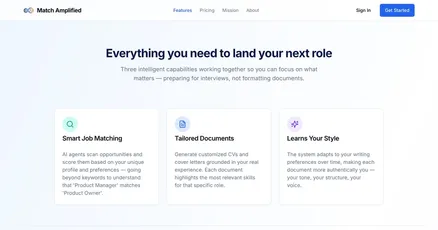
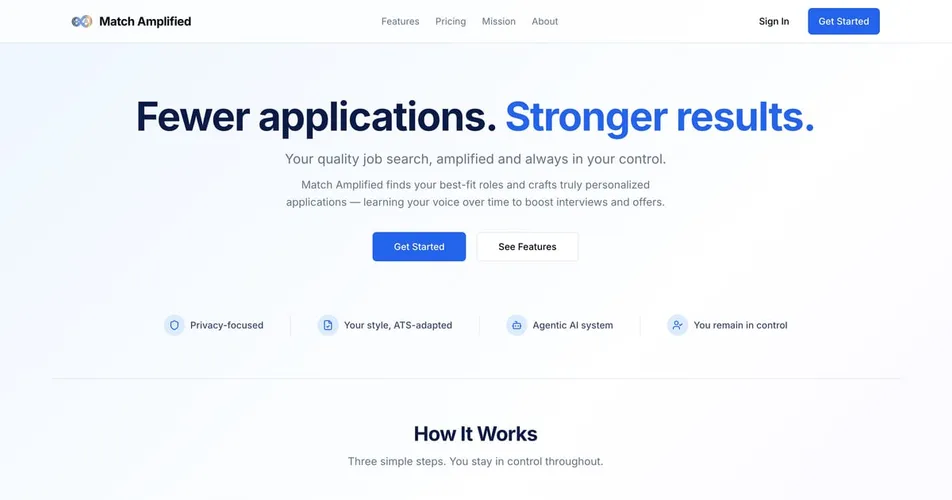
https://www.matchamplified.com
I’ve used Lovable for personal projects before: a winding-down routine webapp, a budget app with receipt “OCR” and LLM-powered auto-categorisation. Prototype, learn, move on.
This time was different. We needed a full SaaS: auth flows, onboarding, a job dashboard, document review screens, a full marketing site.
So I pushed it further than I had before. Here’s what I learned.
What worked brilliantly
The speed is genuinely extraordinary. Full feature development, testing and shipment in hours, not weeks. Lovable generates coherent component structures, not just fragments. My approach: start with a clear spec or PRD, then iterate in small Agile-style chunks, like you would with a real team.
It’s also excellent for iteration on layout and copy. Change the hero heading, reorder sections, adjust spacing. Fast feedback loop, almost no friction.
For a buildathon where the clock is running, this is a real superpower.
Where it hit limits
Fine-grained control is hard. When you know exactly what you want (a specific interaction, a precise layout behaviour), getting Lovable to match it takes more effort than just writing it.
Debugging is opaque. When something breaks, you’re working against a codebase you didn’t write and can’t easily read in context. Root cause tracing takes longer than it should. What helped: precise bug descriptions with repro steps. The more specific, the faster the fix.
And on large codebases, the AI starts to lose coherence across edits. State management becomes fragile. Changes in one place quietly break things somewhere else.
The move that unlocked everything: GitHub
Lovable has a GitHub integration. Connect it, export the code, and from that point you own it completely.
That’s where Claude Code came in. Once the repo was mine, I could iterate directly: read the actual files, understand what was generated, fix things properly and build new features without the Lovable interface. Full visibility. Full control.
The transition wasn’t dramatic. The scaffolding had done its job, so I stopped using it.
I started with Claude Code on the terminal, already a huge step up. Later I moved to the VS Code extension: direct file editing with multiple Claude Code sessions running in parallel. Each step compounds.
The broader point
The line between “no-code” and “code” is blurring fast. Entry cost is low: you scaffold a serious webapp in hours, not weeks.
One caveat: none of this replaces understanding your architecture. You still need to know how the system fits together, both to make better decisions and to push back when the AI takes shortcuts.
The skill that matters now isn’t “can you code from scratch” or “can you prompt an AI.” It’s knowing when to use which mode, when to step in and how to direct the AI tools properly.
Article series on Match Amplified
| # | Topic | JRM Lab | |
|---|---|---|---|
| 1 | The Buildathon and what came after | Buildathon intro on LinkedIn | From the Buildathon to Match Amplified |
| 2 | The agentic AI architecture | Agentic architecture on LinkedIn | Match Amplified: the agentic architecture under the hood |
| 3 | Lovable → Claude Code transition | Lovable to Claude Code on LinkedIn | this article |
| 4 | VPS and infrastructure setup | Infrastructure setup on LinkedIn | Match Amplified: VPS and infrastructure |
| 5 | What’s already built in Match Amplified | What’s built on LinkedIn | Match Amplified: what’s already built |
| 6 | The roadmap | Roadmap on LinkedIn | Match Amplified: the roadmap |
| 7 | The naming process | Naming process on LinkedIn | Match Amplified: choosing the name |
| 8 | Where this all goes from here | What’s next on LinkedIn | Match Amplified: what’s next |
| Try it live: | matchamplified.com |
| Product Compass AI Gallery: | Match Amplified entry |
| Full case study: | Match Amplified product case study |
Share :